
How to Search Harris County Civil Dockets
Start with the court named on the pleading, citation, or cause number. District civil cases belong in the Harris County District Clerk public search. County civil matters use the County Clerk Web Search. A small claim, eviction, debt claim, or other justice-court matter belongs in the JP system. These channels do not duplicate one another.
A cause number is the best key. Without it, gather the exact party or company name, an estimated filing date, case status, and the court level. The District Clerk offers Party Inquiry and case activity tools. The County Clerk form accepts case number, court, status, and filing-date limits, with separate Party, Attorney, and Company tabs. If an online result remains unclear, call the proper clerk or visit its counter rather than guessing from a similar name.
- Identify district, county civil, probate, family, or justice court from the case papers.
- Open that custodian's portal and search the cause number first.
- If needed, search by party, company, court, date, or status.
- Open the matching record and check filings, orders, and settings.
- Ask the correct clerk for a certified judgment or missing image.
Harris County Civil Search Tabs
The County Clerk search separates several kinds of queries. Case Number is the narrow route. Party, Attorney, and Company tabs handle searches when the number is missing. Court, Status, and File Date From and To can trim a broad result set. The portal covers accepted filings from January 3, 1977 forward, but its image coverage starts January 1, 2008. An older case may therefore have a searchable register without an online pleading image.
The official County Clerk civil search shows how these filters are presented.
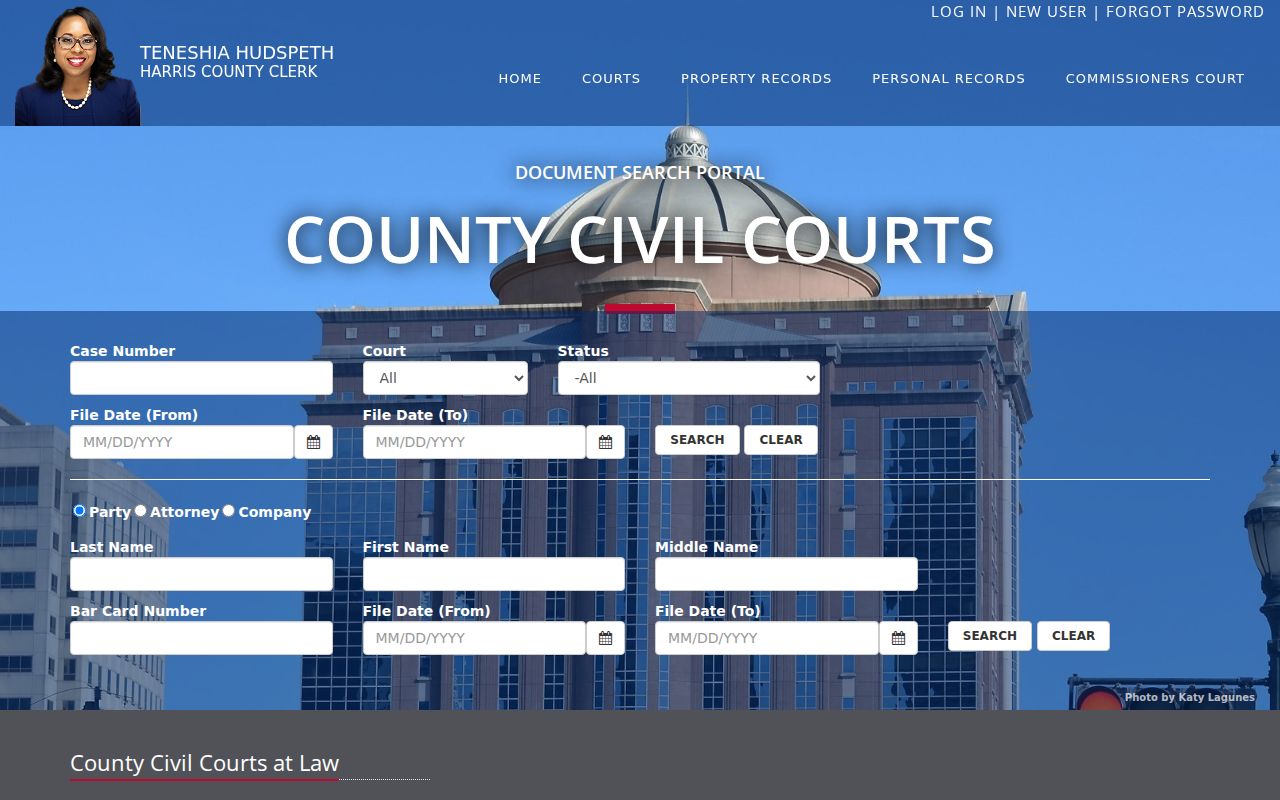
This view helps distinguish a county civil search from the separate District Clerk and justice-court systems.
What a Harris County Civil Docket Shows
A Harris County civil docket is a time-ordered register, not the whole case file. Search results identify the matter, while docket activity tracks the original petition, issuance and service of citation, answers, counterclaims, motions, hearing notices, signed orders, trial settings, nonsuits, dismissals, judgments, and later enforcement or appeal activity. A line stating that an order was signed does not guarantee that its image is free or publicly downloadable.
| Cause Number | The court's unique case key and the best search term. |
|---|---|
| Style | The caption naming the parties to the suit. |
| File Date and Court | When the case began and which court owns its docket. |
| Case Activity | Petitions, service, answers, motions, notices, and orders by date. |
| Setting or Judgment | The next hearing or a signed order, dismissal, or final judgment. |
Read status in context. A reset is a moved setting, not a dismissal. A nonsuit is a party's withdrawal of a claim. DWOP means dismissal for want of prosecution, which concerns a case that has not moved as required. Post-judgment entries may include an abstract or garnishment used to enforce a judgment.
Harris County Civil Setting Tools
District civil schedules are divided among purpose-built tools. The administrative menu has Trials, Coordinator's Settings/Notices, Law Day written submissions, Law Day oral hearings, Other Hearings, Case Activity, Case Setting History, asbestos-case listings, and Civil Docket Inquiry. Docket Inquiry asks for both a date and a civil court. Its own warning says the court, docket-name code, and setting date are required.
The district court web-services menu is useful when a party knows the kind of event but not the right form. Trial Search is not the same as Case Activity. Setting History is better for tracing resets. Coordinator notices may carry court-specific directions that do not appear in the basic register.
The District Clerk e-services page also explains the separate filing route.
View the official Harris County District Clerk e-services source.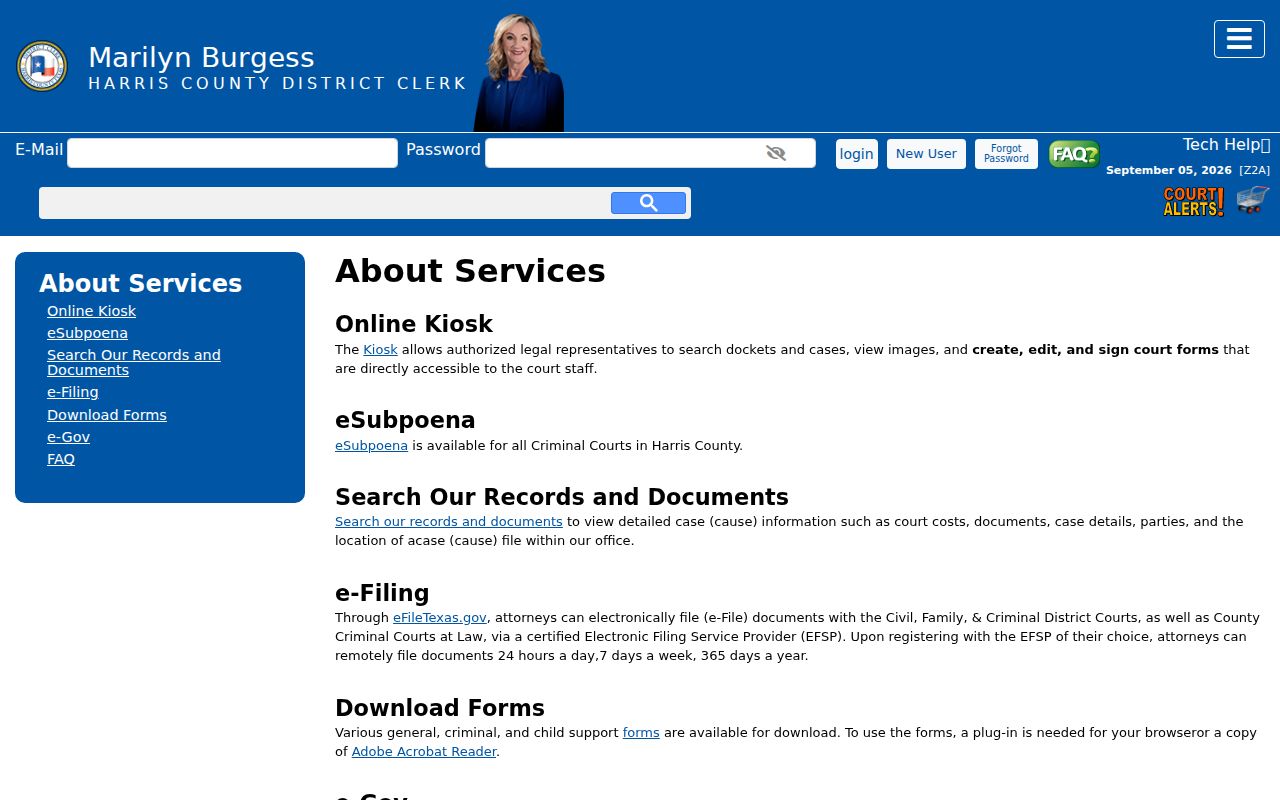
The service list reinforces a key distinction: eFileTexas submits filings, while clerk and court tools display public docket activity.
Types of Harris County Civil Cases
Civil jurisdiction is split. District courts hear broad civil disputes and family matters. County civil courts maintain their own records through the County Clerk. Justice courts handle many small claims, debt cases, and evictions. Probate courts have separate estate, guardianship, heirship, and mental-health calendars. The court level controls both the search site and the clerk who can supply a copy.
- Contract, debt, and other commercial claims
- Personal-injury, tort, and property disputes
- Family matters in the district-court system
- Small claims and evictions in justice courts
- Probate, guardianship, heirship, and estate cases
Probate is not merely another civil search tab. Harris County has five probate courts, with judge-specific schedules and separate mental-health settings. Family document images can also be limited in the District Clerk portal. A missing public image should be treated as an access boundary, not proof that no filing exists.
Harris County Civil Portal Accounts
The County Clerk uses an account and shopping cart for online copy delivery. Registration asks for a username, an email address, a password of at least seven characters with one uppercase letter, confirmation fields, and a security question and answer. The session ends after one hour of inactivity. That matters when reviewing a long civil docket or collecting several available images.
The County Clerk registration page is the source for current account rules.
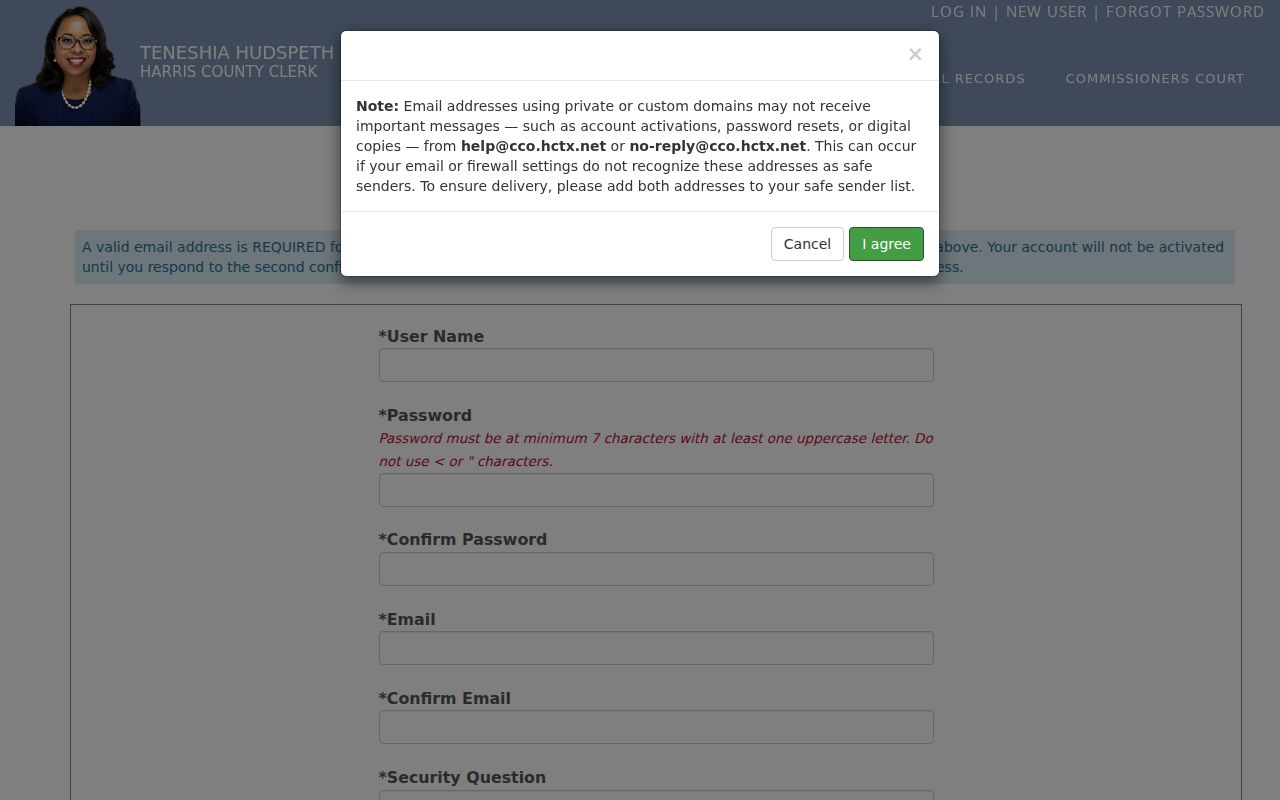
An account grants use of the service; it does not override sealing, family-record limits, or other lawful restrictions.
Harris County Civil Settings and Hearings
A setting should identify the court, date, time, cause number, case style, and setting type when those fields are published. Some notices add a judge, courtroom, or coordinator note. Law Day, docket call, trial setting, and other hearing are distinct labels. The event is scheduled activity, not the outcome of the case.
Check both the current docket entry and the court-specific notice near the hearing date. A continuance or reset moves the event and should appear in later case activity or setting history. If the portal is stale or silent, call the named court coordinator or the District Clerk at 832-927-5800. The Harris County court calendar explains the broader calendar channels.
Current civil district-court pages and the Texas Office of Court Administration directory are safer than an old roster. The present research lists 24 civil district courts at 201 Caroline Street, but schedules, judges, and coordinator details can change.
Harris County Civil Copy Choices
A docket line and a copy are separate products. County Clerk paper copies cost $1 per page. Paper certification adds $5 per document. Electronic noncertified copies cost $1 for up to ten pages, then $0.10 per page above ten within one document. Electronic certified copies use that page rate plus a $5 certification fee. A raised seal requires in-person service even though an electronic certified copy can be emailed.
| Copy | Harris County Clerk Rate | Delivery Note |
|---|---|---|
| Paper, plain | $1 per page | Order from County Clerk Civil |
| Paper, certified | $1 per page plus $5 per document | Raised seal is in person |
| Electronic, plain | $1 through 10 pages; $0.10 after | Per document |
| Electronic, certified | Electronic rate plus $5 | May be emailed without raised seal |
For a county civil item that is not online, use form H0187, write or visit County Clerk Civil at 201 Caroline, Suite 300, Houston, Texas 77002, or call 713-274-1330. Individual case copies and bulk data are different services. Bulk inquiries go to datasales@cco.hctx.net or 713-274-6390.
Public Access to Harris County Civil Dockets
Texas court records are generally open, subject to court rules and specific exceptions. Texas Rule 12 governs judicial records and directs a written request to the custodian. It is not the same path as the Texas Public Information Act for ordinary agency records. The District Clerk also says its PIA form should not replace information already offered online. Clerk-held case records should first go through the clerk's search and copy channels.
Key access rules:
Texas Rule of Judicial Administration 12 provides an inspection and copy process for judicial records, with stated exceptions.
Texas judiciary open-records policy explains why adjudicative court records follow court rules rather than the ordinary agency-request route.
Texas Rule 21c requires handling and redaction of sensitive data in filed documents.
Sealed, restricted, juvenile, family, and mental-health material may produce a limited result, a redaction, or no public image. Rule 21c protects data such as full dates of birth, home addresses, identification numbers, financial-account details, and minors' names. Use the clerk's written process or seek a court order when required. Do not attempt to bypass a restriction.
Public access protects open courts while honoring lawful privacy limits and court orders.
Harris County Historical Civil Files
For a civil file outside the portal's image dates, use the responsible clerk and archive route. The District Clerk Records Center holds records from 1837 forward, while County Clerk civil staff can route older county-court material. A searchable index entry does not mean the image has been digitized.