
How to Search the Harris County Court Docket
Start with the court level. Then narrow things down with the sharpest identifier you hold. The Harris County District Clerk public search covers the widest stretch of local cases. It reaches district civil, family, felony, and county criminal matters. It skips federal cases and Justice Court matters. It also skips cases from other counties and municipal Class C citations. County civil files live in the County Clerk's separate search. A traffic ticket usually stays with the city or Justice Court that issued it. A cause number is the best key of all. Without one, gather the party name, a filing range, the court type, the case or offense type, and the likely court. Name-only searches can drag in unrelated cases. Compare the style, file date, court, and action before opening a result.
- Identify whether the matter is district, county civil, probate, Justice Court, municipal, or federal.
- Open that court's official portal and use the cause number when possible.
- Match the result by court, style, file date, and case type.
- Read the entries and settings, then confirm a future hearing with the named court.
- Ask the proper clerk for a plain or certified document if the docket alone is not enough.
Don't merge results from different portals without checking which office actually holds the record. The County Clerk civil system covers filings accepted from January 3, 1977 forward. Online images begin January 1, 2008. The JP search accepts a case number, a driver-license number, a name with birth date, or a business name. It also wants the court. Federal cases run through PACER. Nothing online? Call the clerk, visit a public terminal, or submit the correct written request. A missing web entry can mean an older case, a different court type, restricted access, or a filing that has not yet reached the public index.
Harris County Portal Search Fields
The District Clerk splits its docket search into several tools rather than one blank form. Party Inquiry takes a party name, role, filing-date range, status, court type, and case or offense type. Quick Docket Search needs just a start date and a court. All Docket Settings adds more. There you gain an end date, a cause-number operator, docket type, SPN, bondsman license number, and sort choice. Historical and trial-judgment searches carry their own fields.
| Search path | Useful inputs | Best use |
|---|---|---|
| Party Inquiry | Name, role, dates, status, court type | Finding a case without its number |
| Quick Docket Search | Start date and court | Checking a court's settings |
| All Docket Settings | Date range, cause number, docket type, court | Narrowing a known setting |
| Historical | Cause number, style, historical range | Locating an older index entry |
The Harris County portal asks you to create an account before it will show public case information. It also uses a CAPTCHA on its forms. Plan on typing your search by hand. Labels on the search tabs can shift from one screen to the next. Trust the controls you see in the live form rather than a fixed list.
Each result row lists the Case or Cause Number, the Style, the File Date, the Court, the Case Region, and the Type of Action or Offense. Those fields are your first identity check. Open a record only after several of them line up with the person or case you are chasing. For civil settings, the administrative search runs on dates and courts. It wants the court, the docket-name code, and the setting date. It also splits out written Law Day matters, oral Law Day hearings, trial settings, other hearings, and asbestos dockets. Picking the right search form is half the work of pulling the correct Harris County court docket.
What a Court Docket Shows
A Harris County court docket names the case and lists its events in date order. You might see a pleading filed. A motion may be set. An order may be signed, or a final disposition reached. It promises no free image of every filing. Family images can be missing from public search. Sealed or sensitive material may appear only as a restricted entry.
| Case Number | The local cause number; Justice Court numbers may carry prefixes such as TR, CR, BC, or EV. |
|---|---|
| Parties | The case style or caption and public party roles. |
| Docket Entries / Filings | Dated pleadings, motions, notices, orders, judgments, and other case events. |
| Hearing Settings | The date, court, setting type, and sometimes time or courtroom. |
| Court & Judge | The court assigned to the case and the judicial officer when published. |
| Disposition | The recorded outcome, dismissal, judgment, sentence, or other closing event. |
Context does the work. A reset means a new setting, not a dismissal. A filing date proves the clerk received an item, not that the judge granted the request. The register may also link to available public images or note that an image exists. Access rules and charges can differ from the index. A judgment entry tells you when the judgment was entered. A certified judgment must still come from the clerk. A hearing setting only forecasts court activity. Later docket entries show whether the hearing occurred, moved, or produced an order, so read forward before assuming anything. Keep a copy of the cause number when you call, because staff can route an exact case far faster than a broad party-name question.
Read Harris County Docket Terms
Harris County calendar labels pack a lot of procedure into a few words. Meaning shifts with case type and court, though certain terms recur across county records.
- Setting
- A scheduled court event. It may be a hearing, conference, docket call, or trial setting.
- Reset
- A setting moved to a new date or time.
- Law Day
- A district civil calendar for written or oral matters, separate from a trial setting.
- DWOP
- Dismissal for want of prosecution, often shown on a show-cause calendar.
- Disposition
- The event or result that resolves a charge, claim, or case.
Criminal dockets use arraignment, bond, plea, capias, and sentence. Civil registers favor citation, answer, nonsuit, summary judgment, and post-judgment activity. An unfamiliar code deserves a quick call to the clerk or coordinator. Municipal courts add compact shorthand of their own. Pasadena's historical docket forms, for example, used ARA for arraignment and MOT for motion, alongside time, case number, citation number, charge, status, and court. Those old forms teach the field layout. They won't find a current appearance. Probate calendars carry another vocabulary, from ancillary and heirship to guardianship, administration, show cause, and mental health, and the record type sets the right meaning.
Which Courts Keep Dockets
Several offices split the record keeping in Harris County. The District Clerk holds district and county criminal records, while the County Clerk handles county civil records. Probate courts, Justice Courts, city municipal courts, and federal courts each maintain their own access routes. Match your case to the right row. That match avoids a false “no result.”
| Court | Docket Covers | Where to Search |
|---|---|---|
| District Courts | Felony, broad civil, and family matters | District Clerk public search |
| County Criminal Courts at Law | Class A and B misdemeanors and certain appeals | District Clerk and court-specific pages |
| County Civil Courts | County-level civil cases | County Clerk Web Search |
| Justice Courts | Eviction, debt, small civil, and JP traffic matters | Harris County JP search and docket display |
| Municipal Courts | City traffic, parking, Class C, and ordinance cases | The issuing city's court |
| Federal Courts | Federal civil, criminal, and bankruptcy cases | PACER or a federal clerk terminal |
Probate works differently from a standard Harris County civil search. Each probate judge keeps separate pages and a calendar. Courts 1 through 4 sit at 201 Caroline, while Court 5 is at 1115 Congress. Family district cases belong to the District Clerk. Public images of family documents can run thin, though. Appeals travel to the First or Fourteenth Court of Appeals in Houston. Once a notice of appeal lands, the appellate court owns the docket from that point forward. Check its records instead of leaning on the trial register alone.
District courts carry the heavy load in Texas. Felony charges, large civil disputes, and family matters land there. The current Harris County civil roster counts 24 civil district courts. A separate tier, the County Criminal Courts at Law, fields 16 courts. Those handle Class A and B misdemeanors plus certain appeals from lower courts. Their individual court pages post schedules, resets, coordinator contacts, and stream links. The District Clerk still holds the official record search.
Justice Courts split by precinct and place. Evictions, debt claims, small civil cases, and some traffic matters fill their dockets. Pick the exact court in the JP form. The same party name can surface elsewhere. Municipal courts answer to cities rather than the county clerk system. They process fine-only Class C cases, traffic and parking tickets, and ordinance violations under their own procedures.
The surest routing clue is the court named on your notice, citation, or pleading. No document in hand? Fall back on the case-number prefix, the dispute type, the issuing agency, and the filing location. A felony allegation points to district court. A county-level misdemeanor points to a County Criminal Court at Law. Evictions point to Justice Court. A city traffic ticket usually points back to the municipal court that issued it. Federal captions identify the United States District Court or Bankruptcy Court.
County Search or re:SearchTX
re:SearchTX is the statewide research portal run by the Texas judiciary. After registering, users can search cases, filings, document text, and hearings. They can then filter results or save them for later. It earns its keep when a case sits outside a single Harris County form. Even so, treat it as a supplement to the local clerk systems, not a replacement.
State reporting flags two limits. The statewide document collection excludes criminal case records. Much of its coverage starts around 2016. For the authoritative local register, certified copies, and current fees, the Harris County clerk remains the source. eFileTexas does a different job entirely: lawyers and parties submit filings through approved providers, and a filing receipt is not a public docket image.
For civil and family research, re:SearchTX stays useful once a filing enters the statewide collection. Its toolkit covers document-text keywords, filing detail, hearing types, filters, saved searches, and exports. Registration or sign-in is required. When you need the authoritative Harris County index, the county portal wins. The same goes for local service details. Approved providers offer eFileTexas at all hours. Acceptance, indexing, public access, and judicial action remain separate stages.
Note: start with the county portal whenever the court and custodian are known.
Finding Court Dates and Settings
Calendar information lives in several places. Options include District Clerk docket settings, district administrative searches, county criminal stream pages, the Justice Court docket display, probate schedules, and municipal portals. For district civil matters, the Docket Inquiry wants a docket date and a civil court number. Trials, coordinator settings, Law Day matters, other hearings, case activity, and setting history each get their own tool.
Settings shift. Match the current docket against the court's notices. Phone the coordinator if a time, courtroom, remote link, or reset stays murky. Justice Court display reaches only the next 60 days, with a seven-day range per query. The Harris County court calendar page walks through each route and covers what to do after a missed or moved setting.
Read every setting with care. Confirm the date, local time, court, judge, courtroom, and setting type. A caption alone will not carry you. County criminal courts start at different times, and remote access is not universal. Some courts ask participants to email a coordinator. A stream link never excuses an appearance, and a calendar listing is not a ruling. Follow the court's notice and your own filed orders.
Harris County Calendar Differences
Probate shows why no single countywide calendar can answer everything. Probate Court 3 posts separate blocks for guardianship, heirship, ancillary matters, scheduling conferences, wills and administration, show-cause matters, and mental-health hearings. Probate Court 4 runs its own calendar with remote-hearing instructions. Each judge's page has the final word.
County criminal courts list start times court by court. Some remote links require a coordinator, and a few courts show no public stream at all. Municipal courts run on city rules. A setting only means the matter is expected to be called. It does not show that a trial happened or that the case ended.
Check again before court. Weather closures and court orders can replace an older docket entry. The district courts' official notices are the best last check for Harris County district settings.
Harris County Justice Court Scale
The Texas Office of Court Administration reported heavy Justice Court activity. The stretch ran from September 1, 2024 through August 31, 2025. Those totals describe the whole county system, not one person or a single court. They also explain a practical point. A narrow search beats a broad name query. Use the court, the date, and the case number every time.
These totals cover Harris County Justice Court cases only. District, county, municipal, probate, and federal dockets are excluded. The year opened with 403,881 active matters. Those active cases spanned civil and criminal proceedings, while 73,128 others were reactivated and 74,422 were moved to inactive status during the period. OCA paired the caseload with a 2024 Harris County population estimate of 5,009,302. Volume on that scale is why court and case filters matter. Filters cannot promise a timeline. Status, age, and clearance measures describe a court system, never a party or an outcome.
Public Access to Dockets
Texas splits court-record access from ordinary agency requests. Docket information is generally open. Sealed, juvenile, mental-health, family, and sensitive material may still be withheld or redacted. A blank or restricted result does not prove that no case exists; it may simply mean the clerk or court must review access first.
Key Rules:
Texas Rule of Judicial Administration 12 - governs access to judicial records held by a court or judicial agency, subject to its exceptions.
Texas judiciary open-records policy - explains why adjudicative court records do not follow the ordinary Public Information Act route.
Texas Rule 21c - requires careful handling of sensitive data such as account, identification, address, birth-date, and minor information.
Ask the office that holds the record. The District Clerk says its Public Information Act form should not replace information already posted online. Texas Rule 12 generally lets you inspect and copy judicial records during regular business hours. Stated exceptions apply. A custodian can require enough detail to identify the record. That also means no office has to create a record that never existed. Clerk-held adjudicative case files follow court access rules. Ordinary county administrative records may instead follow the Texas Public Information Act. So name the record and the office holding it.
Restricted Harris County Case Material
A public register and a document image are different access layers. The docket may name an order without exposing the order itself. Family case images may be unavailable in public search. Juvenile matters are confidential. A sealed filing requires the court's authorized process. Mental-health or probate records can carry special limits too.
Do not hop portals to defeat a restriction. Contact the office that owns the file. That may be the District Clerk, County Clerk, a Justice Court, a municipal clerk, the probate court, or the federal clerk. A court order may be needed. Public copies should never repeat full dates of birth, home addresses, driver-license or passport numbers, financial-account details, or a minor's name.
Expunction and nondisclosure are legal processes, not alternate search filters. Anyone seeking access or relief on a restricted case should use the current clerk and court process. A licensed Texas lawyer is the other option. An entry never proves every alleged fact. A docket is an activity index. Orders, judgments, and the underlying record carry the legal substance, subject to their own access limits.
Docket Entry or Certified Record
A docket says what happened in a case record and when. A plain copy reproduces a filed document. A certified copy carries the clerk's certification. A raised seal may take in-person handling. A transcript usually comes from the court reporter rather than a docket portal.
Printed pages cost $1 each, per the District Clerk's general copy page. Electronic files of one to ten pages also run $1. Longer electronic files drop to $0.10 per page. A certification or seal adds $5 per document. A revised criminal schedule states different combinations for some criminal products. Call the proper desk before paying. The Harris County court records page preserves those distinctions along with the available mail, counter, and form routes.
Mail orders need identifying data and advance payment. The District Clerk copy form asks for the cause number, the item wanted, customer contact details, and payment information. Requests above 100 pages may take more than 24 hours. A primary search can cost $5 when key case information is missing. County Clerk civil copies follow a different fee schedule and order form. Always use the current schedule.
The Clerk and Docket Records
Marilyn Burgess, the elected Harris County District Clerk, maintains the main district and county criminal case systems. Online services run around the clock. The current notice lists weekday lobby service from 8:00 a.m. to 4:00 p.m. Telephone help runs through 4:30 p.m. The Records Center handles searches and documents dating from 1837 to the present. Bring the cause number and style. Criminal copy requests may also require a date of birth.
Harris County District Clerk
1001 Preston, 6th Floor, Suite 630c
Houston, TX 77002
832-927-5800
County civil cases belong to Teneshia Hudspeth's County Clerk Civil Department. It sits at 201 Caroline, Suite 300, Houston. Call 713-274-1330 or write ccoCivilFM@cco.hctx.net. Calling the right clerk matters because one office cannot certify the other's record.
The division inside an office matters too. District Clerk criminal customer service handles criminal docket and copy questions. Civil and family intake, post-trial service, appeals, bonds, writs, and collections each have separate counters. Each may also have its own phone route. County Clerk Civil keeps county civil records and its own electronic and raised-seal products. Court coordinators manage court-specific scheduling. They are no substitute for the clerk who certifies the case record.
Harris County Access Beyond Online
Online tools are not the only road into a Harris County docket. You can call the clerk or court coordinator. Stop at a counter or public terminal. Otherwise you can mail a written request or follow the office's records process. For walk-in searches and copies, go to the District Clerk Records Center. It sits at 5900 Canal Street. Criminal customer service is housed at 1201 Franklin, Suite 3254.
The District Clerk copy page lays out each route. Order in person, by mail, or by drop box. Its public-information form wants a plain description of the record plus your contact details. One caution: a phone call does not count as a formal Public Information Act request. And if the office estimates costs above $100, it may ask for a cash bond. The official page spells out each route for ordering documents.
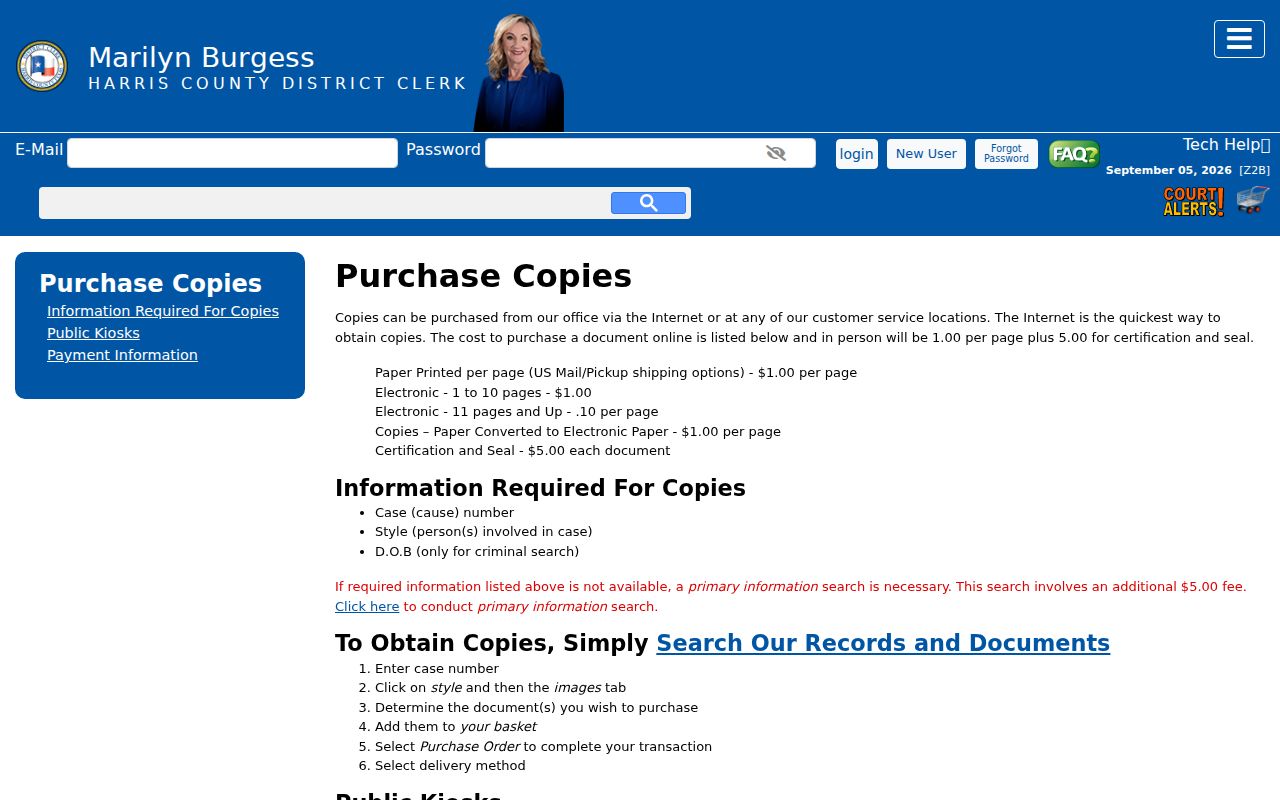
Reading the entry is one task. Pulling the filed document is another, and this view makes that split clear.
Public terminals earn their keep when a login stalls. They help too when images refuse to load or an older index fights you. Bring the cause number, style, court, and rough filing date. Have those ready when you go to a counter. For mail, follow the address and payment form the particular clerk publishes. Phone staff can route you and quote current hours. Even so, the District Clerk is clear that calling never substitutes for a formal Public Information Act request.
Harris County Historical Dockets
Older Harris County court records sometimes live beyond the current case screen. The District Clerk runs historical and trial-judgment search paths. Its Records Center keeps judgments, divorce decrees, and other documents going back to 1837. The County Clerk holds historical records and microfilm of its own. Dates matter here. County Clerk civil portal coverage starts with filings accepted January 3, 1977 forward. Images only begin January 1, 2008.
For requests that outgrow the internet, the District Clerk FAQ can help. It walks through record and copy options.
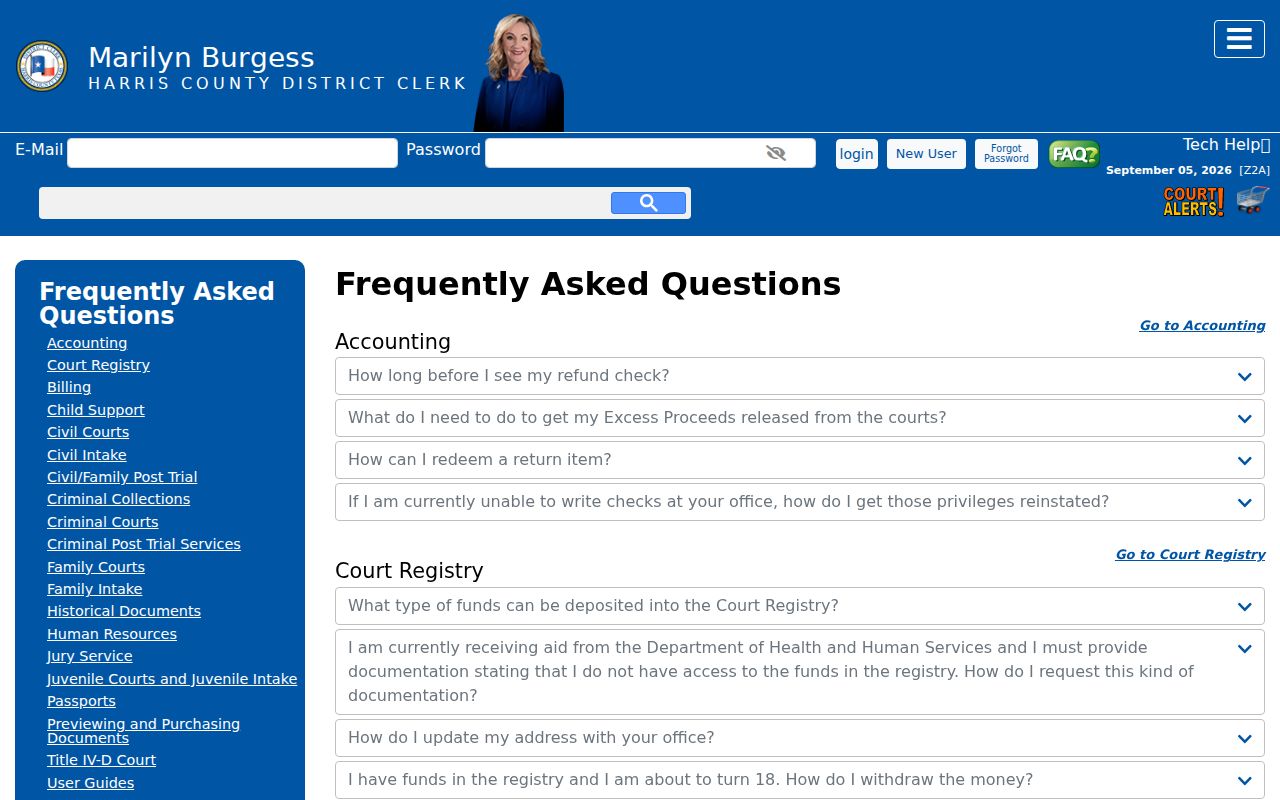
A gap in the record is a gap. Treat it as a question for the office that holds the files. Never treat it as proof a filing never happened.
Harris County has built five courthouses on the downtown square since 1837. The last opened in 1941. The restored 1910 building once held civil courts. It now hosts Texas appellate courts. That long history explains a real quirk. A nineteenth-century case, a modern district docket, and an appealed matter can land in three different collections. Genealogy and civic-history requests should state the era, case style, record type, and court involved.
Harris County Public Search View
The District Clerk's public search splits its tools across separate paths. Case information, party inquiry, historical records, trial judgments, quick docket settings, and all docket settings each get their own entry point.
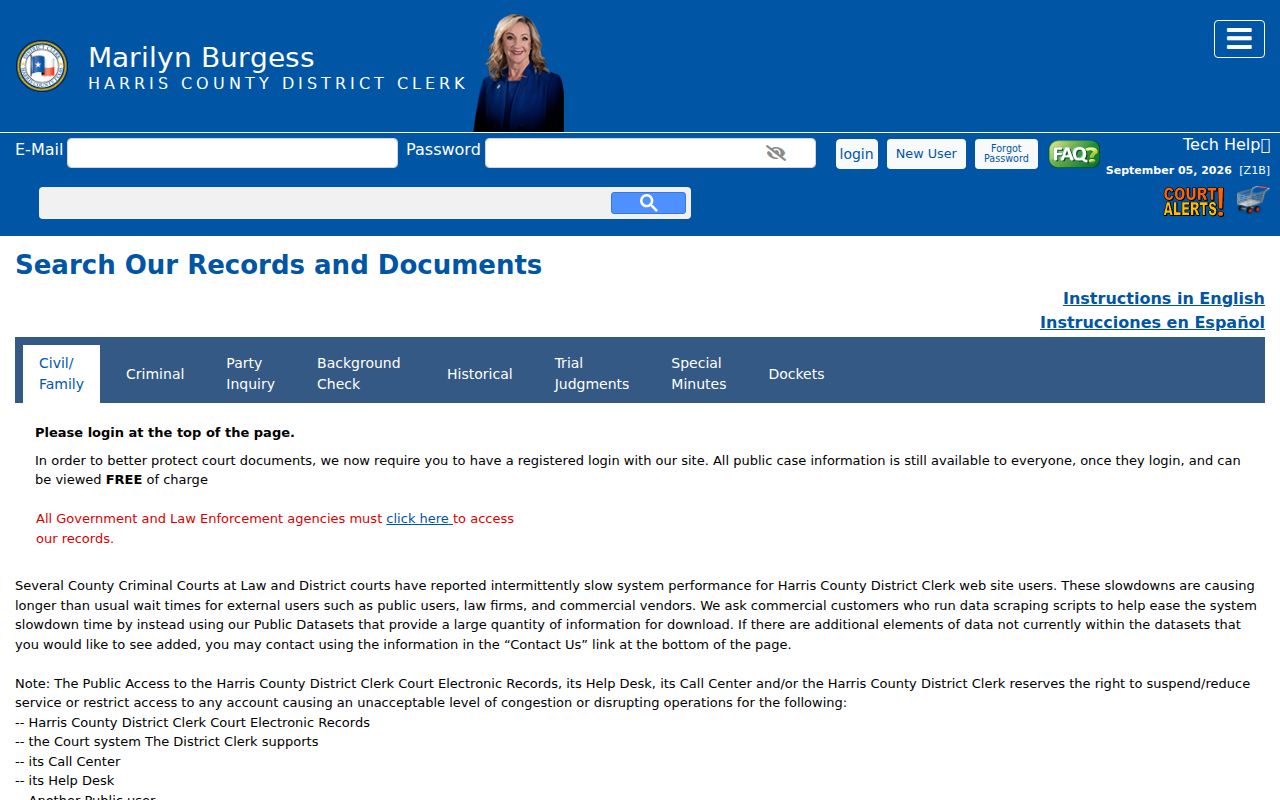
Keep perspective on scope. This portal covers Harris County only. Federal matters belong in PACER, Justice Court cases in the JP system, and municipal citations with the issuing city's court.
PACER is the official docket system for the Southern District of Texas Houston Division and federal bankruptcy. Free public terminals sit in the federal clerk offices. Online PACER use can carry fees. CourtListener's RECAP collection sometimes holds contributed copies, but it stays incomplete and never replaces the official docket. And a federal case never turns into a Harris County District Clerk record just because the events happened in Houston.
Harris County Written Requests
A written request earns its keep when it names the record, court, cause number, case style, and date range. The District Clerk request page goes further, asking for your address, phone, email, and a clear description.
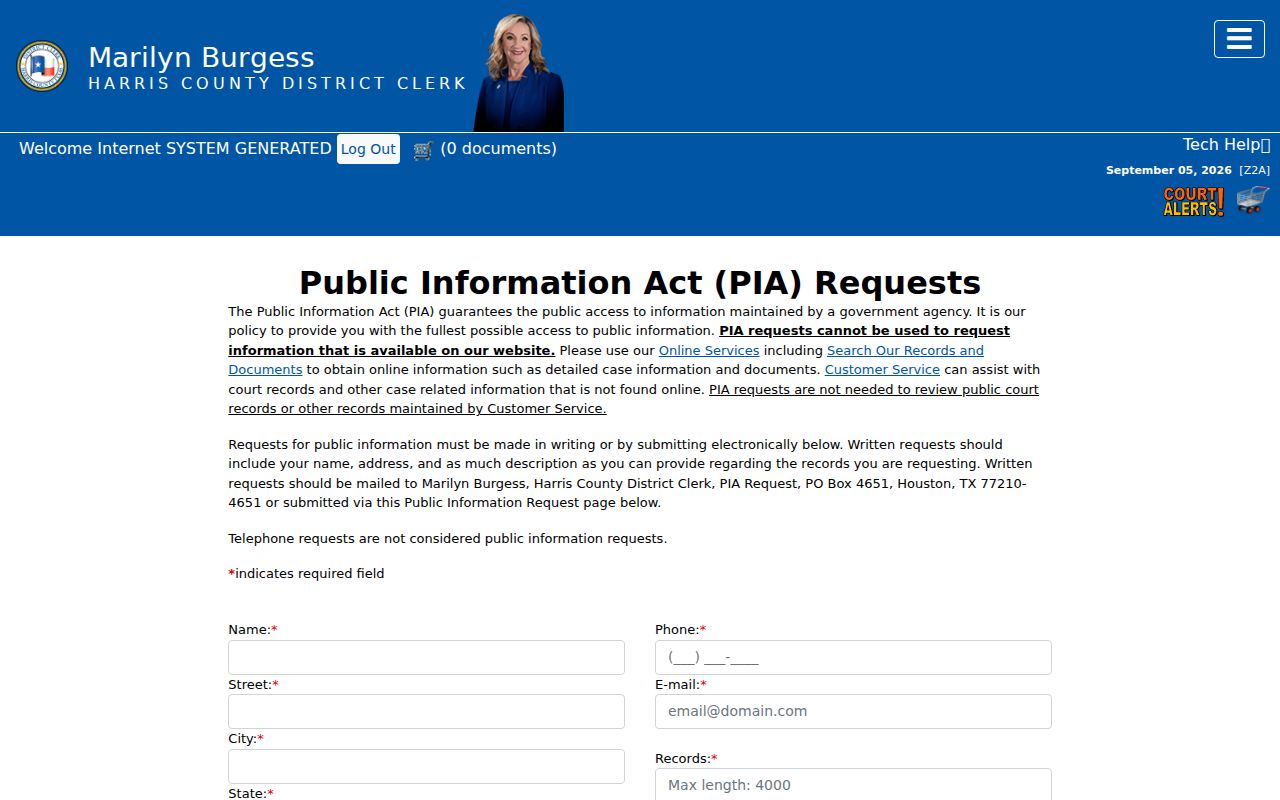
Match the form to the records it governs. County civil, municipal judicial, probate, JP, and federal files each stay with their own custodian.
Skip this route for data already online, the District Clerk advises. Broad requests slow identification. They also raise the estimated cost. Name the exact document, date span, court, and cause number where you can. Charges projected above $100 may trigger a cash bond requirement. County Clerk civil requests, Houston Municipal Court judicial requests, and Texas Rule 12 requests all run on separate forms. Each uses its own delivery channels.
Court Dockets by City in Harris County
Municipal courts keep their own dockets. Class C, traffic, parking, and ordinance cases stay city-side. A Houston ticket will never surface just because you checked the District Clerk. The five cities below appear in the Texas Office of Court Administration's 2024 population order. Each runs distinct search, payment, appearance, and records procedures.
Start with the city named on the citation. Houston takes a ticket number plus a last name or offense date. Officer filing can lag about two weeks, the city warns. Pasadena publishes a trial-docket route. It currently steers payment away from an online system that is down. Pearland, a municipal court of record, handles judicial-record requests under Rule 12. League City gives citation holders 20 working days to contact the court. Baytown keeps judicial records separate from general city public information.
Houston Court Docket
2,390,125 · Ticket search, six court locations, and a separate judicial-record request route.
Pasadena Court Docket
149,617 · Municipal trial docket and city-specific response and payment channels.
Pearland Court Docket
129,620 · Court-of-record procedures for Class C cases within city limits.
League City Court Docket
118,456 · Traffic, parking, Class C, and ordinance settings through the city court.
Baytown Court Docket
86,004 · Citation response, trial, warrant, and judicial-record information.
Map and Directions to the Harris County District Clerk's Office
District Clerk Marilyn Burgess maintains Harris County's principal district-court and county-criminal case records from the office's downtown Houston headquarters at 1001 Preston, 6th Floor, Suite 630c. Civil and family district courts sit a few blocks away at 201 Caroline, and criminal customer service is handled at 1201 Franklin, so calling 832-927-5800 first helps route a records question to the right counter before making the trip.
Harris County District Clerk
1001 Preston, 6th Floor, Suite 630c
Houston, TX 77002
832-927-5800
Lobby service Monday through Friday, 8:00 a.m. to 4:00 p.m.; phone support until 4:30 p.m.; online services run 24/7.
Bring the cause number and case style to any counter, and a date of birth for criminal copy requests. The District Clerk's Records Center at 5900 Canal Street, not this downtown office, holds historical judgments and documents dating back to 1837.